Freddy Cannon Dies at 89: How “Boom Boom” Quietly Shaped Rock and Roll
When most people think of the giants of early rock and roll, the names that come first are usually Elvis, Chuck Berry, Little Richard. Freddy Cannon rarely makes that opening list. And yet, the deeper you dig into where rock actually got its swagger, the more you keep bumping into a guy named Freddy “Boom Boom” Cannon.
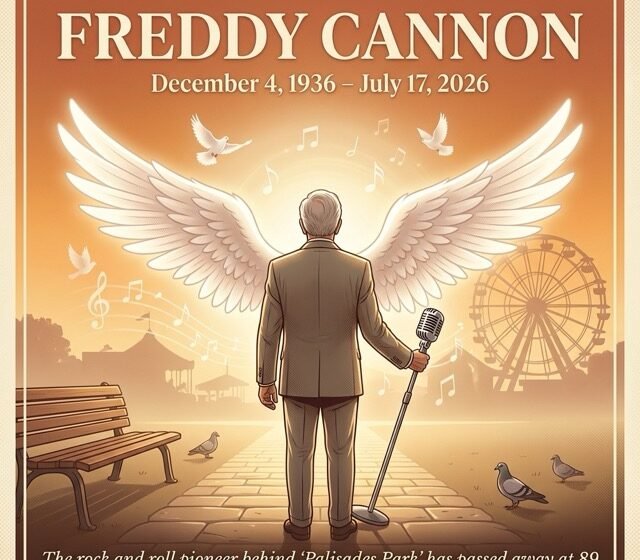
Cannon died on Friday, July 17, 2026, at a hospice facility in Oxnard, California, after a short battle with cancer. He was 89. His longtime friend, iHeartRadio’s Tom Cuddy, confirmed the news. And with him goes one of the last living links to the exact moment rock and roll was inventing itself in real time.
The Sound Before the Legend
Born Frederick Anthony Picariello Jr. on December 4, 1936, in Lynn, Massachusetts, Cannon grew up in a house where music was already in the air — his father sang and played trumpet in local bands. That matters, because Cannon never came off as a manufactured teen idol. The energy was real, and you could hear it.
His 1959 breakout “Tallahassee Lassie” is where the story really starts, and it’s also where you can see the first bit of genius. Dick Clark heard the track and suggested re-cutting it with a heavier, pounding bass drum. That thump became Cannon’s signature — and it’s literally where the nickname “Boom Boom” came from. It sounds like a small production note. It wasn’t. That aggressive low-end drive was ahead of its time, and it’s the thread that connects Cannon to everything loud that came after.
The Part Nobody Talks About: His Influence
Here’s where the obituaries usually stop and where the actual analysis should start. Freddy Cannon wasn’t just a hitmaker with a couple of oldies-radio staples. He was a low-key architect of the sound that later filled stadiums.
Mick Jagger has admitted the groove of the Rolling Stones’ “Brown Sugar” owes something to Cannon’s pounding style. Let that sink in — one of the most iconic riffs in rock history traces a line back to a guy from Massachusetts singing about a lassie from Tallahassee. Robert Plant of Led Zeppelin once confessed that before Zeppelin even had its name, the band cut a blues version of “Tallahassee Lassie.” And Stephen King, arguably the biggest storyteller of the last half-century, has woven Cannon’s music into his novels, name-checking him alongside Elvis and Chuck Berry as the soundtrack of his youth.
That’s the real measure of an artist: not just the chart position, but who was listening in the cheap seats and what they went on to build. By that measure, Cannon punched far above his weight.
The Man Who Refused to Slow the Room Down
There’s a detail from Tom Cuddy that says everything about Cannon’s philosophy: Freddy didn’t do ballads. While his peers chased tearjerkers and slow dances, Cannon built his entire catalog around momentum. He wanted people on their feet, and he kept them there.
That’s harder than it looks. Sincerity and heartbreak are easy to sell in pop music. Pure, sustained joy is one of the toughest things to keep alive across a six-decade career — and Cannon managed it. It’s why he holds the record for the most appearances on Dick Clark’s “American Bandstand” with a staggering 110. Clark didn’t book him that often for the ballads. He booked him because Cannon could electrify a room on command.
His numbers back it up: 22 entries on the Billboard Hot 100, a No. 3 smash with 1962’s “Palisades Park” (written by future “Gong Show” host Chuck Barris), and the distinction of having the first rock and roll album to top the UK Albums Chart with “The Explosive Freddy Cannon.”
Why His Death Actually Matters in 2026
It’s tempting to file Cannon’s passing under “another 1950s star gone.” That misses the bigger picture. Every time one of these founding figures dies, we lose a primary source — a person who was actually in the room when the rules of modern popular music were being written. There aren’t many left.
What makes Cannon’s story land differently is that he never stopped. He was still writing and recording at home in California late in life, and even scored a fresh entry on the UK heritage charts in his final years. That’s not a nostalgia act. That’s a lifer.
Cannon is survived by his children, Conny Weber and Billy Cannon, his sister Mary Lou, five grandchildren and seven great-grandchildren. He was predeceased by his son John, who died in April 2026, and his wife Jeanette, who passed in 2024.
History tends to remember the rebels and the revolutionaries. Freddy “Boom Boom” Cannon deserves to be remembered for something rarer and honestly harder: he made rock and roll fun, and he never let that go. More than sixty years later, drop the needle on “Palisades Park” and it still does exactly what it was built to do — it gets you moving.
Rest in peace, Freddy. The boom echoes on.